
Driven by the "dual carbon" goals, the energy storage industry is entering a period of rapid expansion. The large-scale application of lithium batteries and hydrogen energy storage systems has also made potential safety hazards caused by hydrogen leaks a major obstacle to the industry's development. Issues such as battery thermal runaway and seal failure of hydrogen storage tanks can easily lead to the accumulation of hydrogen within enclosed storage compartments. The explosion limit of hydrogen is as low as 4.0%-75.6% VOL, and even a small electric spark can trigger a catastrophic combustion and explosion accident. Traditional monitoring methods, due to their shortcomings such as lagging response and poor environmental adaptability, struggle to establish a comprehensive safety protection system. Against this backdrop, the UK's QiDun UGT-C5H hydrogen sensor, leveraging 20 years of sensing technology accumulation and targeted innovative breakthroughs, precisely addresses the monitoring pain points in energy storage scenarios, reinforcing the core defense line for energy storage safety, and achieving a leapfrog upgrade from "passive response" to "active prevention and control".
As a technology enterprise with 20 years of deep experience in the field of gas sensing, UK Gas Shield is based on the complex working conditions of energy storage scenarios and breaks through the industry's monitoring bottleneck through technological innovation. Its proprietary UGT-C5H hydrogen sensor, with three core technological breakthroughs, has become the "hardcore equipment" for energy storage safety monitoring. Unlike traditional sensors that are prone to signal drift and response lag in high-temperature and electromagnetic interference environments, UK Gas Shield's hydrogen sensor adopts a "platinum-rhodium alloy catalytic core + adaptive signal processing" technology. Its response time (T90) to hydrogen is ≤20 seconds, far faster than the industry average of 30 seconds. It can instantly capture the slightest leakage of hydrogen inside the energy storage cabinet, providing a critical time window for emergency response measures such as linked exhaust and power cut-off, thus blocking the thermal runaway chain reaction at its source.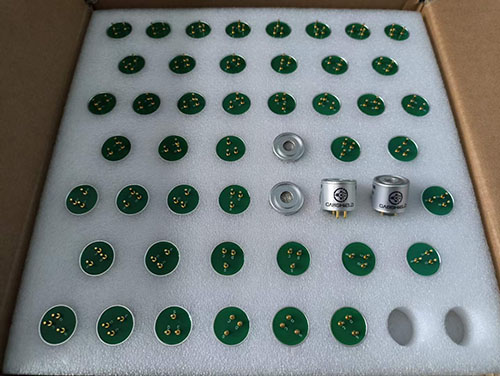
In response to extreme operating conditions such as high and low temperature fluctuations, high humidity, and strong electromagnetic interference in energy storage cabins and cabinets, the British Qidun UGT-C5H hydrogen sensor has achieved breakthroughs in all-round environmental adaptability. With its built-in micro-thermocouple and adaptive temperature compensation algorithm, and relying on ceramic thermal insulation packaging technology, it can operate stably within a wide temperature range of -20℃ to 50℃, with temperature drift controlled within ±3%FS. Even in the early stages of battery thermal runaway, it will not fail to detect temperature increases, perfectly adapting to the complex temperature change requirements of energy storage scenarios.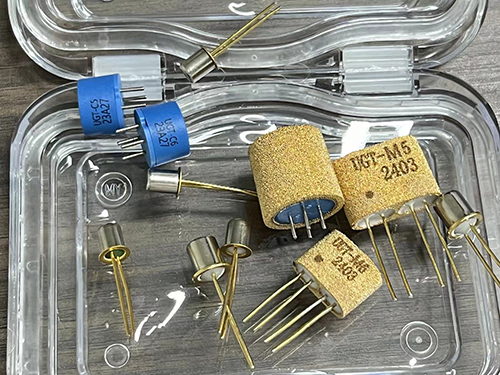
In terms of detection accuracy and range adaptability, the British Qidun UGT-C5H hydrogen sensor achieves dual coverage of "micro-capture + high-concentration prevention and control", precisely meeting the full-cycle requirements of energy storage safety monitoring. Its detection range covers 0-100% LEL, with a resolution of 0.1% LEL. It can not only accurately capture ppm-level micro-hydrogen leaks in the early stages of thermal runaway, providing early warning of battery faults, but also handle high-concentration monitoring in case of severe leaks. It tracks hydrogen concentration changes throughout the process, avoiding the risks of missed and false alarms.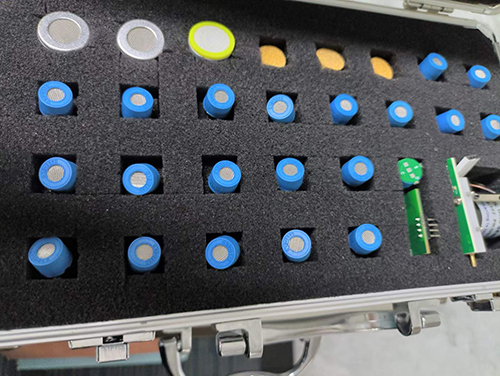
With the gradual implementation of standards such as GB/T46261-2025 "General Technical Requirements for Fire Monitoring and Early Warning System of Electrochemical Energy Storage Power Station", energy storage safety has entered an era of standardization and normalization, and the performance requirements for hydrogen monitoring equipment have been further enhanced. The UK's QiDun UGT-C5H hydrogen sensor has broken through with technological innovation, accurately addressing industry pain points such as slow response, poor environmental adaptability, high operation and maintenance costs, and susceptibility to false alarms and missed alarms of traditional sensors. It not only provides a long-term and reliable hydrogen monitoring solution for energy storage power stations, but also promotes the transformation of energy storage safety protection from "post-disposal" to "pre-warning, active prevention and control".
In the future, as the energy storage industry evolves towards large-scale and diversified development, the scenarios of hydrogen leakage monitoring will become more complex, and the requirements will continue to rise. UK Gas Shield will continue to deeply explore sensor technology innovation, iteratively upgrade products in combination with the needs of energy storage scenarios, further optimize the detection accuracy, environmental adaptability, and linkage performance of sensors, and provide more precise and reliable safety monitoring support for various energy storage systems such as lithium battery energy storage and hydrogen energy storage. This will help the energy storage industry develop in a high-quality, safe, and orderly manner, truly solve the safety challenges of energy storage, and build a solid safety defense line for energy storage.
 Industrial innovation! Technical solution of British gas shield combustible gas sensor in robotic dog
 UK Airshield Ultra-Micro Technology! A Somatic Robot Gas Sensor Launched
 Break through technological barriers! UK Airshield, a super-strong anti-poisoning combustible gas sensor
 Stirring up heated discussions! UK Qidun unveils a new product: a four-gas sensor module
A technology-based company focusing on research and development of gas sensors
Feel Free To Contact Us →